
How to price corporate drop-off catering
Corporate drop-off is a volume business: thinner margins than events, but the same office reorders every week if the first lunch lands right. The trick is pricing fast and consistently, not cheaply. Here is what a realistic 2026 per-person number looks like, and where drop-off caterers quietly give away the margin.
This page is the operating reference for that trade: what the per-head number has to contain, how boxed and shared service differ in cost, where a minimum comes from, how delivery and the drive get priced honestly, and what changes when one office becomes a standing weekly account. The dollar figures are computed from the same 2026 market table the calculator runs.
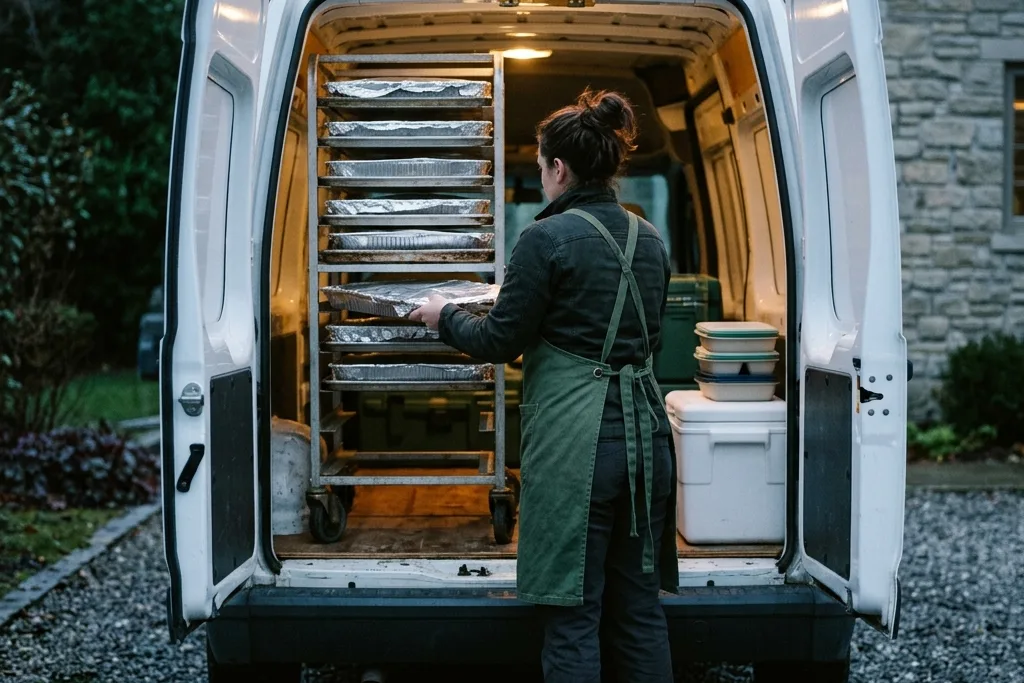
A delivered corporate lunch runs about $23.50 to $39.00 per person on standard proteins with three sides, which is $587.50 to $975.00 for a 25-person office. Drop to budget-tier proteins and the band is $20.50 to $34.00; add staff on site and you are quoting a buffet at $29.50 to $49.00.
The worked number
Per person
$23.50 – $39.00
Total for 25 guests
$587.50 – $975.00
Delivered drop-off, standard protein (a sandwich-and-hot-tray spread), three sides, national cost average. No on-site staff.
What is in the per-person number
The food is the smallest part. Drop-off carries packaging, serviceware, labels, the shopping and prep time, and the drive, all costs a plated event hides inside its service fee. A delivered lunch in the $23.50 to $39.00 band has to absorb every one of them line by line, so cost the whole delivered order per person rather than the sandwich. The tell that this has gone wrong is a quote built by pricing the food and adding a round number for everything else.
Standard proteins, meaning deli meats, roasted chicken, a pasta tray, sit at the middle tier. Trading down to the budget tier moves the band to $20.50 to $34.00 per person, and dropping from three sides to two moves it to $22.00 to $36.00. Trade up to steak or shrimp and you have left the drop-off price band entirely. Most corporate lunches live between budget and standard, because the buyer is spending a department budget and answering to someone who will see the per-head figure.
Boxed and shared service are two different costs
An individually boxed lunch and a shared platter spread can carry the same food and very different economics. Boxing is labor: every guest is an assembly, a label, a container and a lid, and the packaging cost per head is several times a shared tray. What boxing buys is a clean handoff, dietary safety, and an office that does not have to organize itself around a buffet table, which is worth real money to a buyer running a meeting.
Shared platters are cheaper to build and messier to land. They need serving utensils, they need someone in the office to open them, and they make dietary tracking harder. Quote them as different products with different per-head prices rather than treating boxing as a packaging upcharge on the same lunch, and let the client choose against a price rather than a preference.
Minimums, and what the drive really costs
The drive and the packaging run cost about the same whether the order feeds 8 or 40, so the fixed cost of a delivery lands entirely on the headcount. At the low end of the delivered band, an 8-person order bills $188.00 while a 40-person order bills $940.00: the same trip, the same loading, the same parking problem, five times the revenue. That ratio is the entire argument for a minimum.
Set the minimum where the smallest order you are willing to accept still pays for the trip, then hold it. A 12-person order at $282.00 to $468.00 is a reasonable floor for many operations; below that, either the per-head price rises or the order waits for a day you are already going that direction. Publish the minimum rather than applying it case by case, because a minimum a buyer discovers during a negotiation reads as a penalty and a minimum on the order form reads as a policy.
The order that comes back
One-off lunches barely pay; the standing account is where the money is. About a year after a job, that client is due again, and a rebooking reminder is what stops the date slipping past you. It surfaces the clients whose event was roughly eleven or twelve months ago, skips anyone who has ordered from you in the last month, and offers to start the repeat order as a draft, seeded with their name and last year’s job. Nothing reaches the client on its own: you write the message and choose when it goes. Retention, not new logos, is where drop-off caterers actually make rent.
The weekly account changes the math underneath the price too. A repeating order lets you buy against a known quantity, prep in a rhythm rather than a scramble, and route two deliveries into one trip when the buildings are close. That is where the thin per-head margin of drop-off actually turns into a living: not by charging more on any one lunch, but by removing the surprises from fifty of them. Price the first order to be sustainable at the fiftieth.
Labels, allergens, and the count that moves at nine
Corporate lunches are eaten by people who did not order them, which makes labeling part of the product rather than a courtesy. Label every item with its name and its major allergens, keep the vegetarian and gluten-free options visibly separate rather than at the end of a shared tray, and send a short list of what is in the delivery so the organizer can answer questions without calling you. Getting this right is the single most common reason an office reorders from the same caterer.
Then plan for the count moving. Corporate headcounts change the morning of, almost always upward, and almost always by a small number. Decide in advance what you will do: a stated cushion built into the price, a rush rate for additions after the cutoff, or a flat refusal that you actually keep. All three are workable. What loses money is absorbing the change silently every week and calling it customer service.
How a company actually pays you
A department buyer is not a private client and does not behave like one. Expect a purchase order number to be required before delivery in larger organizations, an invoice rather than a card at the door, and payment terms that run on the company’s cycle. Ask for the billing contact and the terms on the first order rather than the first late payment, and put the terms on the quote so the person forwarding it internally is forwarding something complete.
Two documents save weeks. A current certificate of insurance, because many offices will not admit a vendor without one, and a completed tax form so accounts payable can set you up before the first invoice rather than after it. Have both ready to send in a single reply. The caterer who answers a procurement email the same day usually becomes the standing vendor, and the one who takes a week usually does not get asked twice.
The quote that makes reordering easy
Corporate buyers reorder from whatever is easiest to repeat. Give the quote a clean per-head figure, a named menu they can point at, and a delivery window rather than a time, then keep the same structure every week so the comparison is trivial. A standing spread quoted at $23.50 to $39.00 per person that arrives at the same quality on the same schedule is worth more to an office than a cheaper lunch that has to be re-negotiated.
Keep the food price, the delivery charge and any service charge on separate lines, because a company that has to justify the spend internally needs to see what each part is. And put an expiry on the pricing rather than the order: a quarterly review of the per-head number is normal in this trade and far easier than explaining a surprise increase in the middle of a standing account.
Get exact costs from YOUR recipes
These are market ranges. CaterKit photographs your menu, costs every recipe from your ingredients, and prices the quote at your margin — free to start.
Re-run this office lunch with your own headcount and region.
Frequently Asked Questions
How much does corporate drop-off catering cost per person?
A delivered office lunch on standard proteins with three sides runs about $23.50 to $39.00 per person on 2026 national-average pricing, or $587.50 to $975.00 for a 25-person office. Budget-tier proteins run $20.50 to $34.00. Adding staff on site moves it into buffet pricing at $29.50 to $49.00.
Why do caterers set an order minimum for office lunches?
Because the drive, the packaging run and the loading cost the same regardless of headcount. At the low end of the delivered band an 8-person order bills $188.00 against $940.00 for 40 people on the identical trip. A minimum makes sure the smallest order accepted still pays for the delivery it requires.
Should boxed lunches cost more than shared platters?
Usually yes. Boxing is per-guest labor plus a container, a lid and a label for every head, where a shared platter is one build. What the client is buying is a clean handoff, easier dietary handling and no buffet logistics in a meeting room. Price them as two products rather than treating boxing as a packaging surcharge.
How do I handle a headcount that changes on the morning?
Decide the policy before it happens: a small cushion priced into the per-head figure, a stated rush rate for additions after the cutoff, or a firm cutoff you actually hold. Any of the three works. Absorbing the change quietly every week is the option that looks like service and costs a margin.
What do corporate clients need before they can order?
Often a purchase order number, a certificate of insurance and a completed tax form, plus a billing contact and stated payment terms. Send all of it in one reply on the first request. Being easy to set up in a procurement system is a large part of why one caterer becomes the standing vendor and another does not.
Is corporate drop-off worth it at thinner margins than events?
Yes, when it repeats. A single lunch barely pays for the trip, but a standing weekly account lets you buy against a known quantity, prep in a rhythm and combine deliveries, and it arrives without the sales work an event needs. Price the first order so that it is still sustainable at the fiftieth.