
Catering equipment and getting food there safely
New caterers overspend on equipment in two directions at once: they buy a garage full of gear they use twice a year, and they skimp on the two or three pieces that actually keep food safe on the way to the event. The fix is knowing what you touch at every single job versus what you touch occasionally, and treating transport as a discipline instead of an afterthought. Get those two things right and you can cater real events out of a used sedan with a few hundred dollars of carriers.
This chapter covers the equipment that earns its keep, what to rent instead of buy, and the transport rules that keep you off the wrong end of a food-safety call. If you’re still building your overall budget, run this alongside what it costs to start so your gear list matches your cash.
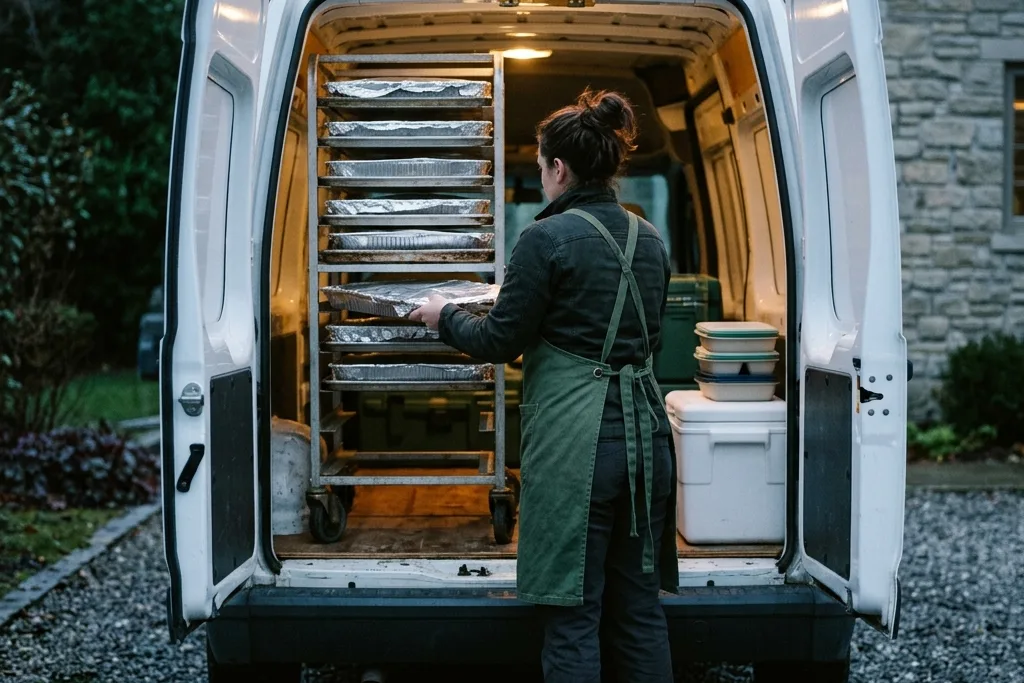
The gear you actually use at every event
Start with the short list — the things that come off the truck at all but the strangest jobs. Buy these, buy them decent, and buy the food-safety ones new.
- Insulated hard-sided carriers. The workhorse. A good “cambro”-style front-loader or top-loader holds hotel pans of hot or cold food at temperature through loading, drive, and hold. This is the single most important purchase you’ll make, because it’s what defends your temps in transit. Have at least two before your first paid job.
- Chafing dishes and fuel. Full-size and half-size frames, water pans, food pans, and a case of gel or wick fuel. Chafers are cheap used; keep spare fuel in the vehicle because running out mid-service is the kind of thing guests remember.
- Sheet pans and hotel pans. Full, half, and third-size hotel pans plus sheet trays are the currency of a catering kitchen — prep, transport, and hold all run on them. Buy used by the stack.
- Thermometers. At least two calibrated instant-read probes, plus spare batteries. This is a food-safety tool, not a gadget — buy it new and keep one in your kit and one in the vehicle. You cannot run safe transport without knowing your numbers.
- Serving utensils and serviceware. Spoons, tongs, ladles, spatulas, and however you’re plating or presenting — chafers with serving lines, platters, or disposables. Match this to how you actually serve.
- Cleaning and sanitizing supplies. Sanitizer, test strips, gloves, clean towels, trash bags, and a way to wash hands on site. Health inspectors and clients both notice a clean setup, and you’ll need it at events without a real kitchen nearby.
Nothing on that list requires a commercial kitchen build-out. If you are outfitting a full commercial setup, a mid-range commercial equipment package runs about $15,000–$30,000 (per Toast, 2025) — ranges, refrigeration, prep tables, a hood, and the rest. But the transport-and-serve kit above is a fraction of that, and it’s all a home-based or commissary caterer needs to start taking jobs. Which path applies to you comes down to your kitchen decision, covered in licenses, permits, and food safety.
Buy what you use every event, rent everything else
The rule that keeps your cash where it belongs: own the gear that touches every job, rent the gear that touches occasional ones.
Buy your carriers, chafers, pans, thermometers, and serving tools — you’ll use them at nearly every event, and per-job rental would cost more than owning inside a few bookings. These are also the pieces you want to know intimately, because familiar gear is fast gear on a tight setup clock.
Rent the rest per job and bill it into the quote:
- Tents, tables, and chairs for outdoor and large events. You do not want these eating your garage or your van.
- Linens — rent, use, return dirty. Owning linens means you’re now in the laundry business.
- Specialty pieces — a coffee urn for a 200-guest morning, a chocolate fountain, extra chafers for one big wedding, a specific serving piece a client wants. Rent it for that event, fold the cost into the price, hand it back Monday.
When a rented piece is costing you more in repeat rental than it would to own, that’s your signal to buy it — let the bookings justify the purchase. Buying ahead of the work is how caterers end up with a fully stocked kit and an empty calendar. There’s more on this rent-before-you-buy logic in startup costs.
The transport rules that keep food safe
This is the part that separates a caterer from someone who cooks. Food doesn’t stop being a food-safety responsibility when it leaves your kitchen — the highest-risk stretch of most jobs is the drive and the setup, exactly when your equipment is doing the work instead of a range or a walk-in.
Learn these numbers and treat them as non-negotiable. Per the FDA Food Code, hot potentially hazardous (TCS) food must be held at 135°F or above and cold TCS food at 41°F or below. The range between — 41°F to 135°F — is the danger zone, where bacteria multiply fast. TCS food left in the danger zone for more than a cumulative 2 hours must be discarded, and here’s the part new caterers miss: that clock is cumulative and it includes cooling, loading, the drive, and setup — not just time sitting out at the event. Every minute the food spends between temperatures counts against the same two hours.
That’s why the discipline matters more than any single piece of gear. Nothing here is legal or health-code advice, and your local health department may hold you to stricter rules — but the physics don’t change.
Loading, driving, and checking on arrival
Put the temperature science to work with a routine you run the same way every job:
- Load with a buffer. Bring hot food up past the minimum before it goes in the carrier — pull it hotter than 135°F so the inevitable drift during the drive still lands you safely above the line on arrival. Same logic cold: get it well below 41°F and packed tight in a cold carrier before you load. Carriers hold temperature; they don’t create it, so start with margin.
- Keep hot and cold separated. Don’t stack a pan of chilled salad against a pan of hot protein in the same carrier. Dedicate carriers to hot or cold and pack them full — a full carrier holds temperature far better than a half-empty one.
- Drive it, don’t detour it. The two-hour clock is running the whole time. Load last, go straight there, and don’t run errands with a truck full of TCS food.
- Check temps on arrival — every time. Probe hot and cold items the moment you’re set up, before service. This is what the thermometer in your vehicle is for. If a hot item has slipped into the danger zone and you can’t confirm how long it’s been there, that food comes off the line. A discarded pan hurts; a room of sick guests ends a catering business.
- Log it if you can. A quick note of load temp, arrival temp, and time makes you faster next time and gives you a record if anyone ever asks. It also trains your instincts for how your specific gear and drive behave.
Use the vehicle you already own
You do not need a wrapped van to cater your first fifty events. A caterer’s transport problem is almost never horsepower — it’s holding temperature, and that’s solved by carriers, not by the vehicle.
Start with the car, SUV, or truck you already own. Lay down a mat or liner you can wipe clean, secure the carriers so they don’t slide and dump on a turn, and go. A sedan with two good cambros and a cold carrier can move food for a 100-guest event perfectly safely. The money you’d sink into a van in year one buys a lot of carriers, chafers, and thermometers — the things that actually keep you booking and keep food safe.
Buy the van when the work demands it: when you’re running enough back-to-back jobs that a dedicated, easy-to-clean, temperature-friendly cargo space saves you real time and risk. Let the calendar justify the vehicle, the same way you let bookings justify every other purchase. Until then, your car plus disciplined transport beats a shiny van plus sloppy temps every single time. When you’re ready to sequence these purchases against everything else, head back to the start hub.
Two things help you size this kit against real work rather than a wish list. What a chafing dish setup involves covers the pans, fuel, and water that a hot buffet needs beyond the frame itself, which is where the count usually goes wrong. And the catering price-per-person calculator gives you the market range a job of a given size lands in, so you can see what a purchase has to earn back and over how many events.
Frequently Asked Questions
- What equipment do I need to start catering?
- Start with the essentials: insulated food-transport carriers (cambro-style hot/cold boxes), chafing dishes with fuel for holding on site, sheet pans and prep tools, food thermometers, serving utensils and serviceware, and cleaning supplies. Buy specialty equipment against real bookings, and rent large or one-off items (tents, extra chafers, specialty serving pieces) per event until the volume justifies owning them.
- How do I transport catering food safely?
- Keep food out of the danger zone in transit: hot food at 135°F or above, cold food at 41°F or below (FDA Food Code). Use hard-sided insulated carriers that hold temperature without power, and build in a buffer — load hot food hotter than the minimum and cold food colder — because temperature drifts on the road. Check temperatures with a thermometer when you arrive, and track how long food has been out.
- What temperature does catered food need to stay at?
- Hot potentially hazardous food must be held at 135°F or above and cold at 41°F or below; the range in between (41–135°F) is the danger zone. Per the FDA Food Code, food left in that zone for more than a cumulative 2 hours must be discarded — and that clock includes cooling, loading, transport, and setup, not just service time. A thermometer and a timer are cheap insurance against a foodborne-illness incident.
- Should I buy or rent catering equipment?
- Buy the gear you use at every event — carriers, chafers, thermometers, basic serviceware — because renting them repeatedly costs more fast. Rent the big or occasional items (tents, tables, linens, specialty serving pieces, extra chafing dishes for a large job) until a specific type of event books often enough to justify owning the equipment. Let your booking pattern, not a wish list, drive purchases.
Quote your first job in minutes, not evenings
CaterKit is built for solo and small-crew caterers — photograph your menu, send a costed, branded quote the same night, and walk into event day with auto-built shopping and prep lists. The Free tier handles 2 events a month, enough to book your first jobs, with no card required.
Get this as a 7-day course
One short email a day, the whole start-to-first-job path, written for someone doing this for the first time. Unsubscribe with one tap, any time.
You're in. Day one lands within a day. Check the promotions tab if it hides.
That didn't send. Check the address and try once more.