
BBQ catering portions: how much meat per person
Under-cook and you run out in front of the client; over-cook and you eat the margin. BBQ portioning is a planning problem with a few reliable rules of thumb. Here is how much cooked meat to plan per guest, why the raw weight is always higher, and how to turn pounds into a price.
This page walks the whole chain: the per-guest cooked weight and what changes it, why several proteins do not add up, the yield that turns cooked pounds back into a shopping list, the pieces you count rather than weigh, the sides and service style that quietly change how much meat a guest takes, and the math that turns all of it into a per-person price. The dollar figures are computed from the same 2026 market table the price-per-person calculator runs.
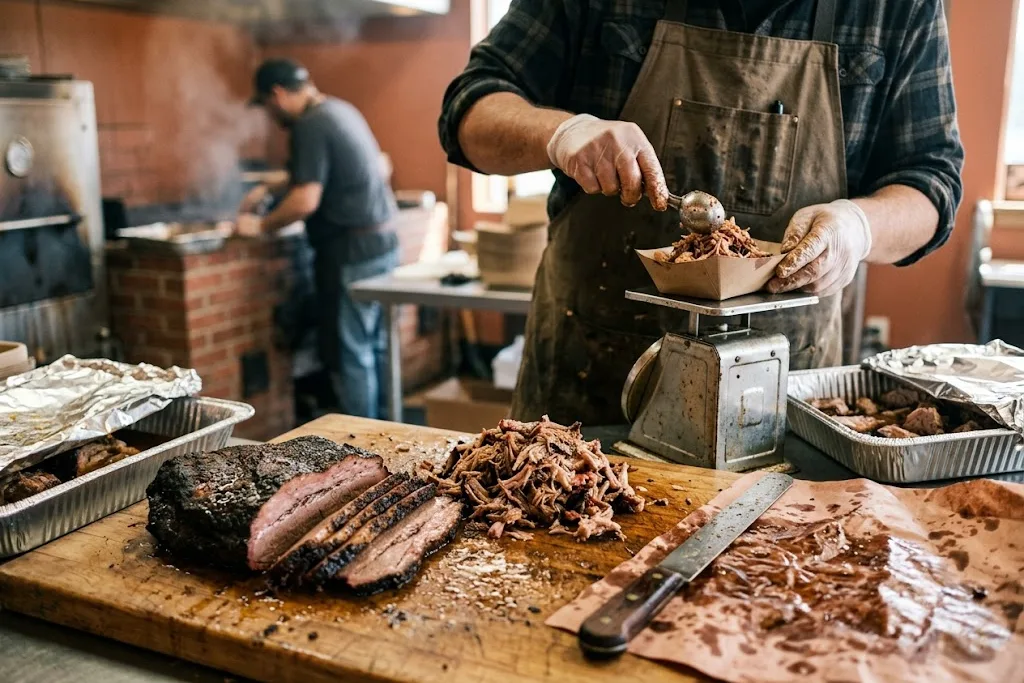
Plan a third to a half pound of cooked meat per adult when BBQ is the main event, toward a third with hearty sides and toward a half for a meat-forward spread. Buy against that cooked weight scaled up by your own yield, because brisket can render down to roughly half its raw weight. Priced out, a staffed BBQ buffet lands around $29.50 to $49.00 per person.
The worked number
Per person
$29.50 – $49.00
Total for 75 guests
$2,212.50 – $3,675.00
A staffed BBQ buffet for 75 guests on standard smoked proteins with three sides, national cost average. The portion plan on this page is what fills it.
The per-guest rule of thumb
Plan around a third to a half pound of cooked meat per adult when BBQ is the main event. Lean toward a third when there are hearty sides, bread on the table and a mixed crowd; lean toward a half or a little more for a meat-forward spread, a hungry group, or a long event where people go back. These are trade rules of thumb rather than findings from any one study, and your own service records beat all of them.
Adjust for who is eating before you adjust for anything else. A wedding with a cocktail hour and a full dessert table takes less meat a head than a graduation lunch where the BBQ is the whole meal. Children count as roughly half an adult for planning, and a late-evening event where guests have already eaten somewhere else can come in well under the low end of the range.
Several proteins do not add up
The most expensive portioning error in BBQ is planning a full portion of each meat. The same guest samples across them, so three proteins share one third-to-half-pound plate rather than tripling it. Split the per-person weight across the proteins instead, weighted toward the one guests reach for first, which is almost always the brisket whenever brisket is on the line.
What does change with a third protein is everything except the meat: another pan, another pair of tongs, another holding space, another stretch of pit time and another line on the prep list. Offer a third protein as a substitution rather than an addition and the plate stays the same size while the kitchen stays sane on the day.
Raw to cooked: the yield that eats your margin
You buy raw and you serve cooked, and low and slow loses a lot in between. Brisket can render down to roughly half its raw weight by the time it is trimmed and smoked; pork shoulder holds on to more; chicken more again. Buy against the cooked weight you need, scaled up by your own measured yield, because planning off raw weight is how you come up short at the pit.
Measure the yield once and write it down. Weigh a whole packer in, weigh the sliced and chopped yield out, and keep that number on the same sheet as your portion plan. Yields drift with your supplier, your trim style and your cook, so a figure you measured yourself two seasons ago is worth more than a figure from anywhere else and less than a figure from this year.
Turning the plan into a shopping list
Work it in one direction only: guests times cooked ounces gives cooked pounds, cooked pounds divided by your yield gives raw pounds, raw pounds times your invoice price gives the meat cost. Add the cushion at the cooked-weight step rather than the raw one, so the cushion is a number of servings you can picture rather than a percentage you guessed at.
A cushion of about five percent is cheap insurance at most headcounts. Running out in front of a client costs the referral that would have paid for the next three jobs; leftovers cost the difference between the raw price and nothing. The asymmetry is severe enough that the honest planning error is to be slightly long, every single time, and to have a plan for the surplus.
Wings, ribs, and the proteins counted by the piece
Not everything in BBQ weighs the same way. Ribs are planned by the bone and by the rack rather than by the pound, and a half rack a person is a common planning figure when ribs share the plate with other meats. Wings are counted by the piece, usually somewhere around six to eight a head as part of a spread. Sausage is planned by the link and cut on the line.
Keep those on their own line of the plan and convert them to cooked weight only when you need a total. Mixing a piece count into a pound plan is how a rib order comes out generous and a brisket order comes out short in the same service, which is the worst of both errors: you paid for extra and you still ran out of the thing guests wanted most.
Sides, service style, and how much a guest takes
Portioning is not only about the meat. A line with three substantial sides, bread and pickles pulls meat consumption toward the low end of the range, because guests fill a plate rather than fill it with brisket. A thin side offering does the opposite, and a self-serve line with tongs and no portion control does it hardest of all, usually on the first pass.
Service style changes the number as much as appetite does. A staffed line where somebody plates the meat holds the portion you planned; a self-serve line where guests help themselves runs over it, sometimes by a lot. If the client wants self-serve, plan toward the high end of the range or put someone on the meat and quote for them rather than absorbing the difference.
Turning pounds into a price
Once you know cooked pounds per guest and your yield, cost each protein by its served portion, add the sides, bread, sauces and consumables, load labor and overhead, and quote one per-person figure. On the market band, a staffed BBQ buffet at a standard protein tier with three sides runs $29.50 to $49.00 per person, which is $2,212.50 to $3,675.00 for the 75 guests in the example above.
Then check your plate against that band. At $29.50 per person a 30% food-cost target leaves roughly $8.85 of ingredients a head, and at $49.00 it leaves about $14.70. If your portion plan costs more than the upper figure, the plan and the price disagree, and one of the two has to move before the quote goes out.
Write the plan down before the season starts
A portion plan you keep in your head is re-invented under pressure every Friday. Put the cooked ounces per guest, the yield for each protein, the cushion, and the piece counts for ribs and wings on one page, and quote from that page. The value is not really the numbers; it is that the same numbers get used twice in a row and can therefore be corrected.
Then close the loop after each event. Note what came back, what ran out, and what guests actually reached for, and move one number on the sheet. Three or four events of that beats every rule of thumb on this page, because it is your food, your crowd and your pit rather than an average of everybody else’s.
Get exact costs from YOUR recipes
These are market ranges. CaterKit photographs your menu, costs every recipe from your ingredients, and prices the quote at your margin — free to start.
Frequently Asked Questions
How much meat per person for BBQ?
Plan about a third to a half pound of cooked meat per adult when BBQ is the main event: toward a third when there are hearty sides and lighter eaters, toward a half or more for a meat-forward spread or a hungry crowd. That is cooked, served weight, not what you buy raw.
How much BBQ do I need when I serve several meats?
Multiple proteins do not add up. The same guest samples each one, so split the per-person weight across them rather than stacking a half pound of every meat. Three proteins share a single third-to-half-pound plate, weighted toward whichever one guests reach for first.
How much raw meat do I buy for smoked BBQ?
Buy against the cooked weight you need, scaled up by your own measured yield. Low and slow loses a lot in the smoker: brisket can render down to roughly half its raw weight once trimmed and smoked, while pork shoulder and chicken hold on to more but never all of it. Planning off raw weight is how you come up short at the pit.
How much brisket per person for catering?
Plan the same third to a half pound of cooked meat per adult, but buy roughly double the raw weight, since brisket can lose about half of it in trimming and smoking. If brisket shares the plate with pulled pork or chicken, split that per-person weight across the proteins rather than planning a full portion of each.
How many ribs or wings should I plan per person?
Count them by the piece rather than by the pound. A half rack a person is a common planning figure when ribs share the plate with other meats, and wings usually land somewhere around six to eight a head as part of a spread. Keep piece counts on their own line of the plan.
How do I turn BBQ portions into a price?
Once you know cooked pounds per guest and your yield, cost each protein by its served portion, add the sides and consumables, load labor and overhead, and quote per person. A staffed BBQ buffet at a standard protein tier with three sides lands around $29.50 to $49.00 per person, or $2,212.50 to $3,675.00 for 75 guests.