
How to price BBQ catering per person
BBQ is bought by the pound and eaten by the plate, and caterers lose money in the gap. Price per person off your real cooked-pound costs and the graduation party stops being a guess made at the register. Here is a realistic 2026 per-person range and what actually moves it.
Use this page as the working reference: the band each service style lands in, how far the protein choice swings it, the cooked-yield math that turns pounds into a plate, the consumables and pit hours that never make it onto a quote, and the check that tells you whether the market band can carry your menu at all. Every dollar figure below is computed from the same open 2026 market table the price-per-person calculator runs.
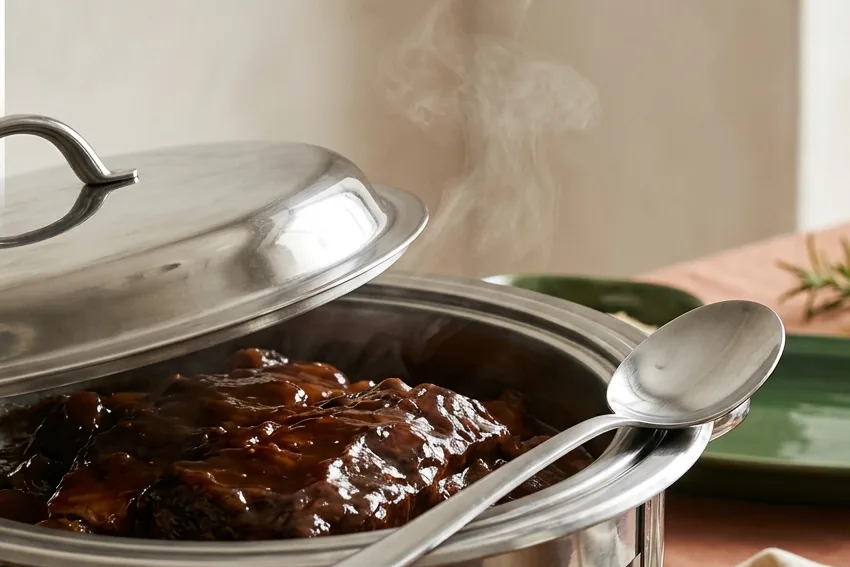
A staffed BBQ buffet runs about $29.50 to $49.00 per person on standard smoked proteins with three sides, or $2,212.50 to $3,675.00 for 75 guests. Delivered as a drop-off spread the same menu is $23.50 to $39.00 per person, and a plated, full-service BBQ dinner runs $43.50 to $71.00. Your own number moves with the proteins you smoke and your region.
Per-person BBQ pricing by service style
| Service style | Per person |
|---|---|
| Drop-off (delivered) | $23.50 – $39.00 |
| Buffet (staffed) | $29.50 – $49.00 |
| Plated (full service) | $43.50 – $71.00 |
Typical 2026 per-person BBQ pricing by service style, at a standard protein tier, three sides, and the national cost average. The calculator adjusts the protein, sides, and region.
The worked number
Per person
$29.50 – $49.00
Total for 75 guests
$2,212.50 – $3,675.00
Staffed buffet service, standard smoked proteins (pulled pork and chicken), three sides, national cost average, at 75 guests.
Per person or per pound?
Clients think in how much brisket; you have to think in cost per head. Quote per person so the number is comparable to every other quote in their inbox and so the sides, bread, sauces, pickles and service all sit inside one figure. Then use your per-pound portions as the check that the food really feeds the headcount. Per pound is your cost math; per person is your price.
The two get confused because BBQ is one of the few trades where the client has a retail reference. They know roughly what a pound of brisket costs at a counter, and they will do math with it. A per-person price ends that conversation before it starts, and it prices the six hours of pit time that a pound price silently gives away.
What the band looks like, by service style
Delivered and set out for guests to serve themselves, a standard smoked spread with three sides lands at $23.50 to $39.00 per person, or $1,762.50 to $2,925.00 across 75 guests. Put somebody behind the line to slice, keep the pans full and manage the sauce, and you are quoting a staffed buffet at $29.50 to $49.00 per person, which is $2,212.50 to $3,675.00 for the same event.
The step between the two is $6.00 to $10.00 a head and none of it is extra food. Plated, full-service BBQ runs $43.50 to $71.00 per person, which few clients ask for and fewer caterers price correctly. Quote each as its own product with its own description, because a client choosing between three named services argues about the service rather than about the meat.
The protein decides the range
Brisket is the most expensive plate in BBQ twice over: it costs more per raw pound than pork shoulder or chicken, and it loses the most weight in the smoker, so its cost per served portion sits far above either. A brisket-forward menu prices a full tier up, at $34.50 to $59.00 per person on a staffed buffet, which is a step of $5.00 to $10.00 a head.
The other direction is worth quoting too. A chicken-and-sausage spread on the same staffed service runs $26.50 to $44.00 per person, $3.00 to $5.00 a head below the standard tier. Offer all three as named menus rather than one price with a shrug, because the protein is the line clients change their minds about, and a named menu turns a yes into a number they had already seen.
Cooked pounds, not raw pounds
Every BBQ cost sheet that goes wrong goes wrong here. You buy raw and you serve cooked, and low and slow renders a lot away in between. Brisket can come down to roughly half its raw weight once trimmed and smoked; pork shoulder holds on to more; chicken more again. Those are typical trade ranges rather than measurements from your pit, and yours are the only ones that matter.
So cost the served portion and buy against it. Decide the cooked ounces a guest gets, divide by your own measured yield to get the raw weight, and price from the raw invoice. A sheet built the other way round, from raw pounds straight to a price, quietly under-prices every brisket order you take and over-prices the chicken ones.
Sides, bread, and the fourth side
Sides are the cheapest way to make a BBQ spread read generous, and they are the line clients notice. A fourth side adds $1.50 to $3.00 per person to the market band, which is less than most clients expect for a visibly fuller table and a visibly less crowded meat count. Quote it as a named upgrade rather than folding it into a single price.
Bread, pickles, onion and sauce are not sides and they are not free. They are a fixed part of the plate that scales with every guest, they carry their own containers and spoons, and they run out first at a self-serve line. Cost them in alongside the sides rather than treating them as garnish, because a BBQ spread without them reads incomplete no matter how good the meat is.
Consumables, fuel, and the pit hours nobody bills
BBQ runs heavy on consumables: chafing fuel, foil pans, butcher paper, gloves, sauce cups, serving utensils, plates and napkins. Put them on the quote as a line rather than absorbing them, because they scale with the headcount and they are completely invisible in a food cost that only counts meat. At a hundred guests they are real money, and no client has ever refused a quote over them.
The pit is the cost most sheets miss entirely. Wood or fuel is the small part; the hours are the large one. An overnight brisket is a night of somebody watching a fire, and that is labor whether or not anyone was paid for it on the day. Load a labor percentage onto every portion before you set the margin, and count the overnight as work rather than as passion.
The math, walked
Cost the plate, then hold it against the band. Add up one guest’s food at your real cooked yields: every protein, the sides, the bread and pickles, the sauce, and the consumables that guest will actually use. Load that with your labor and overhead, then divide by your target food-cost percentage to get a price. Running it the other way tells you what the market leaves you to work with.
At the staffed band’s low end of $29.50 per person, a 30% food-cost target implies about $8.85 of ingredients a head, and at the top of that band, $49.00, about $14.70. If your real cost per guest lands well above the upper figure, a brisket menu at market price cannot carry itself, and the answer is a different menu or a different service style rather than a thinner margin.
Turning the bands into your own sheet
Write one page with the three service styles down the side and the three protein tiers across it, and put a per-person price in every cell. A staffed buffet for 100 guests on the standard tier is $2,950.00 to $4,900.00, and having that total to hand means a Saturday phone call gets an answer while the client is still on the phone. Speed reads as professionalism in a trade where slow replies are the norm.
Then put the things that are not per-person underneath: delivery, staffing, the minimum order you will travel for, the rush rate for a count that moves late, and the date the sheet expires. Review it whenever your protein invoice moves, which in this trade is more often than anyone would like. A sheet six months stale prices last season’s brisket at this season’s prices.
Get exact costs from YOUR recipes
These are market ranges. CaterKit photographs your menu, costs every recipe from your ingredients, and prices the quote at your margin — free to start.
Frequently Asked Questions
How much does BBQ catering cost per person?
A staffed BBQ buffet on standard smoked proteins with three sides runs about $29.50 to $49.00 per person on 2026 national-average pricing, or $2,212.50 to $3,675.00 for 75 guests. A delivered drop-off spread runs $23.50 to $39.00 and a plated dinner $43.50 to $71.00. Your real number moves with the proteins you serve and your region.
Should I price BBQ catering per person or per pound?
Quote per person, and use your per-pound portions only to check that the food actually feeds the headcount. Per pound is your cost math; per person is your price. A per-person figure keeps the sides, bread, sauces and service in one number the client can compare, and it prices the pit hours a pound price gives away.
Why does brisket cost more per person than pulled pork or chicken?
Brisket costs more per raw pound and loses the most weight in the smoker, so its cost per served portion sits far above pork or chicken. A brisket-forward staffed buffet prices at $34.50 to $59.00 per person, a step of $5.00 to $10.00 a head above the standard tier. Cost each protein by its served portion.
How much cheaper is drop-off BBQ than a staffed buffet?
About $6.00 to $10.00 a head: $23.50 to $39.00 per person delivered against $29.50 to $49.00 staffed, on the same standard proteins and three sides. The gap is service labor rather than food, so quote them as two separate products instead of offering one as a discount off the other.
What costs do people forget in a BBQ catering quote?
Consumables and pit hours. Chafing fuel, foil pans, butcher paper, gloves, sauce cups, utensils, plates and napkins all scale with the headcount, and an overnight brisket is a night of somebody watching a fire. Load both onto every portion before you set the margin, or they quietly eat it.
How do I make a BBQ catering pricing sheet?
Cost each protein by its served cooked portion, add the sides, bread and consumables, then publish one per-person price for each service style and protein tier. A staffed buffet for 100 guests on the standard tier is $2,950.00 to $4,900.00. Put delivery, staffing, your minimum and an expiry date underneath the grid.