
Food cost percentage for caterers: the 28–35% rule
The classic rule: raw ingredient cost should land around 28–35% of your menu price. Under that and clients start balking at the price; over it and you are the one paying for the party.
But the rule is a sanity check, not a pricing method. Food is only the visible cost. Your labor and overhead are real lines too, and skipping them is how a "profitable" job pays less than minimum wage.
This page is the working reference behind that sentence: both directions of the formula, the loaded cost the percentage hides, the point where a margin target and the 28–35% band disagree, and the order to work the levers in when a plate comes out too expensive. Every figure below is computed by the same costing engine the margin calculator runs.
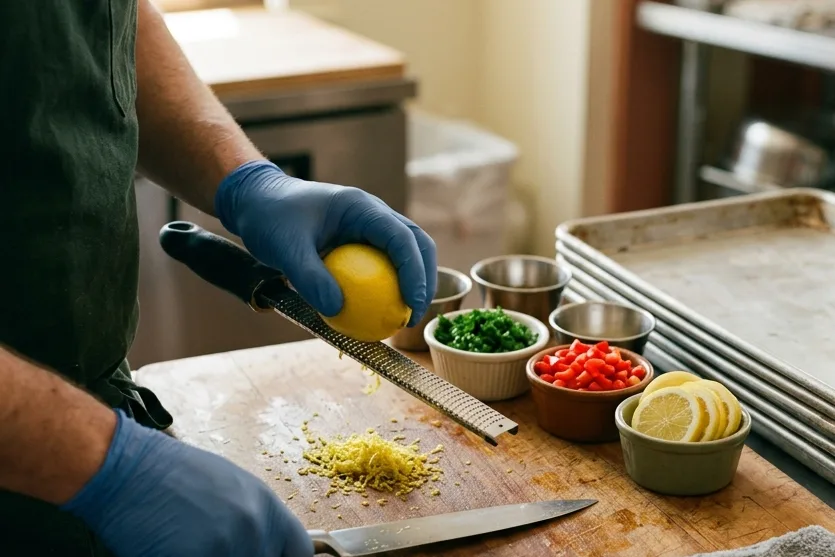
Aim for raw ingredient cost around 28–35% of menu price. On the worked plate below, $4.50 of ingredients sold at $14.50 is 31% food cost, and after labor and overhead the same plate still returns 57% margin on a loaded cost of $6.30.
The worked number
Food-cost percentage
31%
Margin after labor & overhead
57%
What the portion really costs, loaded
$6.30
A portion that costs $4.50 in ingredients, priced at $14.50, with labor at 25% and overhead at 15% of ingredient cost.
The rule, in both directions
Food cost percentage is ingredient cost divided by menu price. Run it forward to grade a price you already have: $4.50 of ingredients on a plate sold at $14.50 is 31%, comfortably inside the band. Run it backward to find a price from a cost: divide the ingredient cost by your target percentage instead of multiplying by it. Those two divisions are the whole rule, and between them they answer most of the pricing questions that arrive by text message on a Tuesday night.
Use the forward direction on menus you already sell and the backward direction on anything new. The backward direction is the faster honest quote, because it needs only one number you already know and one number you already decided. It is also the direction that goes wrong quietly, since a target percentage chosen out of habit rather than from your own costs produces a confident price that has never been checked against a payroll.
Loaded cost is the number the percentage hides
Ingredients are not what a portion costs you. Add the prep and service hours it consumes and the overhead it carries and you get the loaded cost, which is the figure a margin is actually earned over. On the worked plate, $4.50 of ingredients at 25% labor and 15% overhead loads to $6.30. That is the number to hold against a price, and it is why two plates with identical food cost can pay very differently: a labor-heavy dish and a labor-light one look the same to the rule and nothing alike to your month.
The practical consequence is that food cost percentage grades the shopping and margin grades the business. A caterer who only watches the percentage will keep choosing dishes that photograph well and take three hours of hand work, then wonder why a season of good-looking jobs paid badly. Watch both numbers on the same screen and the tradeoff becomes visible before the menu is agreed rather than after the event.
Why the band sits at 28–35%
The band is not a law of nature; it is what is left after the other claims on a price. Labor commonly takes another quarter to a third of the price in catering, overhead takes insurance, packaging, fuel, licenses and the phone, and profit is meant to take what remains. Those are typical trade ranges rather than measured findings, and yours will differ, but the shape holds: if food alone is already taking 45%, there is no math left over for you no matter how full the calendar looks.
Pushing food cost far below the band is its own mistake. Catering buys for one event, often near retail, with waste and specialty items built in, so a very low percentage usually means thin portions rather than clever buying. Portions are the one thing guests actually judge, and a plate that reads mean costs the referral that would have paid for the next three jobs. Premium menus legitimately run higher: a steak dinner at 38% can out-earn a pasta buffet at 30%, because percentages are a compass and dollars are the destination.
Reading your own number
Below 28%, ask whether the portion is honest and whether the price is defensible for what is visibly on the plate. Between 28% and 35%, the plate is doing its job and the next question is whether the labor fits. Above 35%, the food is eating the money the rest of the business needs, and the answer is almost never to shrink the portion first. Above 45%, stop quoting and rebuild the dish, because no service style or staffing plan rescues a plate that far out of band.
Grade dishes individually and the menu as a whole. One generous signature dish at 40% is a marketing expense you chose; a menu averaging 40% is a pricing failure you did not notice. Keep the average inside the band and let the standout dish be the exception that sells the rest of the sheet.
Where the rule and a margin target disagree
This is the part the rule alone will not tell you. Take the same $4.50 plate and price it from a margin target instead of a food-cost target. A 30% margin on the loaded cost of $6.30 prices the plate at $9.00, which is a food cost of 50%: nowhere near the band. A 40% margin prices it at $10.50, or 43% food cost. A 50% margin prices it at $12.60, or 36%.
Only at a 58% margin target does the same plate price at $15.00 and land at 30% food cost, right in the middle of the band. That ladder is the honest reconciliation: the 28–35% rule is not a modest target dressed as a percentage, it is a fairly demanding margin expressed in a different unit. If a margin target you thought was healthy produces a food cost of 50%, the target was the optimistic number, not the rule.
The levers, in the order that costs you least
Reprice first. If the honest cost puts a plate at 42%, the price may simply be too low, and moving it is the only lever that does not touch what the guest receives. Second, swap the one or two ingredients driving the cost: a different cut, a seasonal vegetable instead of an out-of-season one, a house sauce instead of a bottled specialty. Third, right-size the portion to accurate rather than thin, since many kitchens over-portion out of fear and a measured five ounces beats an eyeballed seven on both cost and consistency.
Fourth, buy differently: case pricing, a restaurant-supply membership, or a second vendor for the two items that dominate the sheet. Work them in that order and the guest experience is the last thing touched rather than the first. Reversing the order is how a caterer trims a plate into a complaint and saves less than a repriced quote would have earned.
How a plate cost meets a market price
A plate cost and a market range answer different questions, and mixing them is a common source of confused quotes. The food-cost math above is one dish. The market bands published on this site are a whole delivered head: for a staffed buffet at a standard protein tier with three sides, $29.50 to $49.00 per person, covering the food, the packaging, the service labor and the equipment. A single plate priced at $14.50 sits below that band because it is not the same thing.
Use them together. Cost the dishes to know what the food must earn, then check the per-head total against the market band to know whether the finished quote will read normal to a client comparing three of them. A quote that clears your margin and sits inside the band is a quote you can send tonight without a second thought. One that clears your margin and sits far outside the band is worth a look at the menu before it goes.
Close the month, not the plate
Plate-level percentages are a design tool; the number that decides whether the business works is the blended figure across everything you actually sold. Total the ingredient spend for a month and divide it by the revenue those ingredients produced. That figure includes the waste, the comped tray, the over-ordering on the job where the count dropped, and the two jobs you took at a favor price. It is always worse than the sheet and it is the only one that pays wages.
Two numbers make every future inquiry math instead of a gut feeling at eleven at night: what a portion really costs you loaded, and the margin your month needs. Write them both down, run each new dish against them, and re-run the whole menu whenever a supplier moves a price. The rule stays the same; the inputs are what rot.
Get exact costs from YOUR recipes
These are market ranges. CaterKit photographs your menu, costs every recipe from your ingredients, and prices the quote at your margin — free to start.
Frequently Asked Questions
What is a good food cost percentage for catering?
Aim for roughly 28–35% of menu price. That band leaves room for labor, overhead, and profit, which are typically the larger claims on a catering price. Below 28% usually means thin portions or unusually good buying; above 35% means the food is eating money the rest of the business needs.
How do I calculate food cost percentage on a plate?
Divide ingredient cost by menu price and multiply by 100. The worked plate on this page costs $4.50 in ingredients and sells at $14.50, which is 31% food cost. To go the other way and find a price from a cost, divide the ingredient cost by your target percentage instead.
What is loaded cost, and why does it matter more than food cost?
Loaded cost is the ingredient cost with labor and overhead added, which is the figure a margin is actually earned over. The worked plate loads from $4.50 to $6.30 at 25% labor and 15% overhead. Two dishes with identical food cost can load very differently, which is why a labor-heavy menu can grade well and still pay badly.
What margin do I need to hit a 30% food cost?
More than most people expect. On a $4.50 plate at 25% labor and 15% overhead, a 30% margin target prices the plate at $9.00, which is 50% food cost. It takes a 58% margin target, pricing at $15.00, to land at 30% food cost.
My food cost came out too high. What should I change first?
Reprice first, because it is the only lever that leaves the plate alone. Then swap the one or two ingredients driving the cost, then right-size the portion to accurate rather than thin, then look at case pricing or a second vendor. Changing the plate before changing the price is how a cost problem becomes a complaint.
Should every dish sit inside the 28–35% band?
The menu average should; individual dishes need not. One generous signature dish at a higher percentage can be a deliberate marketing choice that sells the rest of the sheet. A whole menu averaging above the band is a pricing failure rather than a choice, and it shows up as a full calendar and a thin month.
What is prime cost in catering?
Prime cost is food plus labor. For many catering jobs it lands somewhere around 55–65% of the price as a typical working range, leaving overhead and profit to share what remains. If prime cost climbs much past that, there is very little margin left regardless of how the food-cost percentage alone reads.