
How to price a taco bar for 100
The taco bar is the most-requested quote in catering: crowd-pleasing, scales cleanly, and clients think it should be cheap. Here is what a realistic 2026 number looks like for 100 guests, and where caterers quietly lose money on it.
Treat this page as the working reference rather than a read: the price band for each way you can serve it, the portions behind the shopping list, the math that turns a plate cost into a quote, and the lines that decide whether the job pays you. Every dollar figure below is computed from the same open 2026 market table the price-per-person calculator runs, so the numbers here and the numbers there cannot disagree.
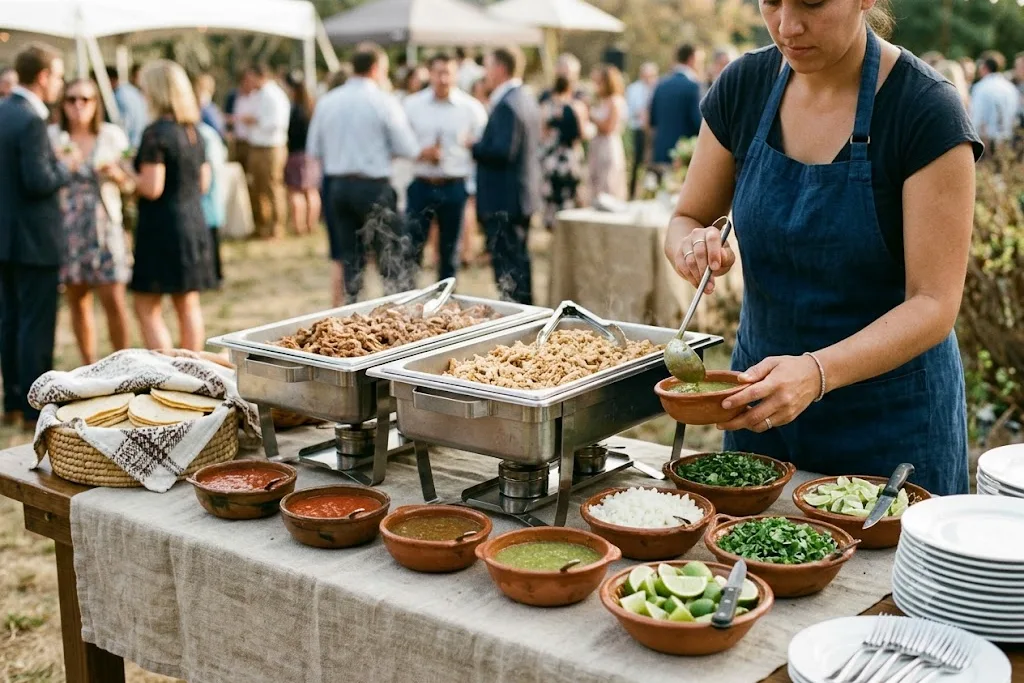
A taco bar for 100 guests runs about $20.50 to $34.00 per person delivered, or $2,050.00 to $3,400.00 for the event, on budget-tier proteins with three sides. Staff the line and it steps to $26.50 to $44.00 per person, because at that point you are selling service as well as food.
The worked number
Per person
$20.50 – $34.00
Total for 100 guests
$2,050.00 – $3,400.00
Drop-off service, budget-tier proteins (chicken, carnitas, beans), three sides (rice, salsas, chips), national cost average.
What 100 guests costs, by service style
Delivered and set out for guests to build themselves, a budget-protein taco bar with three sides lands at $20.50 to $34.00 per person, or $2,050.00 to $3,400.00 across 100 guests. Put someone behind the line to warm tortillas and keep the pans full and you are quoting a staffed buffet: $26.50 to $44.00 per person, $2,650.00 to $4,400.00 for the event. A plated taco course, which few clients ask for and fewer caterers price correctly, runs $40.50 to $66.00 per person.
Those bands assume the proteins most taco bars are built on. Trade chicken and carnitas for carne asada, birria, or shrimp and the whole page moves up a protein tier, to $23.50 to $39.00 per person delivered. That is a step of $3.00 to $5.00 a head, the largest editable line in a taco bar quote and the one clients change their minds about most. Quote it as a named upgrade rather than folding it into a single price, so a yes on the upgrade is a yes to a number they already saw.
The portion plan behind the shopping list
Taco bars run on a handful of planning ranges most kitchens converge on. These are typical trade rules of thumb rather than measurements from any one study, and your own service records beat all of them: guests build two to three tacos each; total cooked protein lands around five ounces a head once rice, beans, and chips are on the line; tortillas run three per guest plus a cushion, mixed corn and flour; rice and beans run roughly four ounces each per guest.
Two adjustments matter more than the base numbers. A second protein does not double the meat, because guests sample across proteins, so split the same five ounces rather than planning five ounces of each. And plan a meatless option for roughly one guest in six unless the client says otherwise, counting it inside the total rather than on top of it. Both mistakes point the same direction, which is why over-buying is the most common taco bar error and the least visible one: nothing goes wrong on the day, the margin is simply gone.
Where a taco bar quietly gets expensive
The proteins are the headline and the toppings are the leak. Every topping needs its own vessel, its own spoon, and its own refill, so a taco bar carries far more small containers and service hardware than a spread of the same price built on two hot trays. Cheese, sour cream, and guacamole are the three that surprise people: cheap by the scoop, real money across 100 guests, and avocado in particular swings hard enough season to season that quoting it at last quarter’s price is a genuine risk.
Consumables are the rest of it: chafing fuel, foil pans, serving utensils, gloves, labels, plates, and napkins. Put them in the price as a line rather than absorbing them. The drive belongs there too. A taco bar for 100 is a van load rather than a car load, and the loading, driving, and unloading is service labor whether or not anyone stays to tend the line.
Drop-off, set-up, and staffed are three products
Decide which one you are selling before you price it. Drop-off means you deliver a finished spread in serving vessels and leave. Set-up means you build the line, light the fuel, and leave. Staffed means somebody of yours is there for the whole service window. Each carries labor the one before it did not, and the market bands step with it: $20.50 at the bottom of the delivered band against $26.50 at the bottom of the staffed one.
The decision rule is short. If the client wants tortillas warmed to order, meat that stays hot past about ninety minutes, or a line that looks tended all evening, quote staffed. If they want good food on a table at noon, quote drop-off and say plainly what happens after you leave. The expensive failure is quoting drop-off and then staffing it anyway because the party looked like it needed help, which turns a profitable job into a break-even one on the day.
The math, walked
Cost the plate, then check it against the band. Add up one guest’s food at your real cooked yields: both proteins, tortillas, rice, beans, every topping by weight, chips, and the consumables that guest will actually use. Load that with your labor and overhead. Then divide by your target food-cost percentage to get a price. Running it the other way tells you what the market leaves you: at the delivered band’s low end of $20.50 per person, a 30% food-cost target implies about $6.15 of ingredients a head, and at the top of that band, $34.00, it implies about $10.20.
That check is honest in both directions. If your real ingredient cost per guest lands well above $10.20, a delivered taco bar at market price cannot carry the menu, and the answer is a different menu or a different service style rather than a thinner margin. If it lands well below $6.15, check the portions before you celebrate: a taco bar that costs almost nothing to build usually has almost nothing on it, and the client counts bowls.
Upgrades that pay, and two that rarely do
Extra sides are the cheapest way to make a taco bar read generous: a fourth side adds $1.50 to $3.00 per person to the market band, less than most clients expect for a visibly fuller table. A protein upgrade adds $3.00 to $5.00. Staffing is the biggest step of the three and the one most worth selling, because it is the difference between food on a table and an event that runs.
Two upgrades rarely pay. A third protein splits the same five ounces three ways while tripling the prep, the pan count, and the holding space, so offer it as a substitution rather than an addition. Complimentary guacamole is a variable-cost line dressed as a courtesy: price it as its own add-on and a bad avocado month becomes the client’s decision instead of your loss.
What goes on the client’s copy
Itemize what they get: both proteins named appetizingly, the tortillas, the rice and beans, the topping bar listed out, chips and salsas, and whether you are setting up. Show the total and the per-person figure together, because the per-person number is the one they compare against every other quote in their inbox. Keep delivery, staffing, and any rentals on their own lines rather than inside the food price, so the food reads competitive and each charge can be discussed on its own terms.
Then put a deposit line and an expiry date on it. A June taco bar quoted at February prices is a real loss when avocados move, and an expiry date is the only thing that reliably stops an old quote coming back. Your itemized costs stay on your side of the table: the client’s copy is a menu with a number on it.
The mistake underneath all the others
Even drop-off carries labor: the shopping trip, prep the day before, morning assembly, the delivery window, and the pans that come back. If the quote only marks up ingredients, the job pays for the party and not for you. Load a labor percentage onto every portion before you set the margin, and treat the labor number as a real cost rather than a rounding allowance.
The tell that this has gone wrong is a full calendar and a thin month. Taco bars are high-volume work, so a small per-head error repeats fast: a shortfall of a dollar a guest across four hundred-person jobs is a month of your own wages. Price one taco bar properly and the rest of the season inherits the fix.
Get exact costs from YOUR recipes
These are market ranges. CaterKit photographs your menu, costs every recipe from your ingredients, and prices the quote at your margin — free to start.
Frequently Asked Questions
How much does a taco bar for 100 people cost?
A delivered taco bar for 100 with budget-tier proteins and three sides runs about $20.50 to $34.00 per person, or $2,050.00 to $3,400.00 for the event, on 2026 national-average pricing. A staffed line runs $26.50 to $44.00 per person. Upgrade the proteins to carne asada or shrimp and add $3.00 to $5.00 a head on top.
How much meat do I need for a taco bar for 100?
A typical planning range is about five ounces of cooked protein per guest when rice, beans, and chips are also on the line, so roughly 31 pounds cooked for 100 guests. Split that across your proteins rather than planning a full portion of each, and buy raw against your own measured cooking loss, which for braised and shredded meats commonly runs a quarter to a third of the raw weight.
How many tortillas should I order for 100 guests?
Plan three per guest plus a cushion, which lands around 330 for 100 people, mixed corn and flour so both preferences are covered. Double-layer eaters and longer events push that up. Tortillas are cheap enough per unit that running short is far more expensive than the extra package.
Is a staffed taco bar worth charging more for?
Yes, and the gap is bigger than most caterers charge for it. The market band steps from $20.50 to $34.00 per person delivered to $26.50 to $44.00 staffed, because a tended line is service hours, not extra food. Quote the two as separate products with their own descriptions rather than offering staffing as a small surcharge on a drop-off price.
What is the most expensive part of a taco bar?
Usually the second protein, then the toppings. Beef, carne asada, and shrimp cost far more per served portion than chicken or beans, and cheese, sour cream, and guacamole add up quietly across 100 guests. Consumables are the line most often left off entirely: fuel, foil pans, utensils, gloves, plates, and napkins are real money at this headcount.
How do I stop a taco bar quote from losing money?
Cost the whole delivered plate rather than the meat, load labor and overhead onto it before setting a margin, and check the result against the market band: $20.50 to $34.00 per person delivered leaves roughly $6.15 to $10.20 of ingredients a head at a 30% food-cost target. Then put delivery, staffing, and rentals on their own lines, and give the quote an expiry date.