
Menu planning that actually makes money
A catering menu is a costing problem wearing a chef’s coat. You will be tempted to design it the way you cook for friends — around the dishes you love and the ones that impress. That instinct is how new caterers end up booked solid and broke. The menu is the single biggest lever you have on profit, and most of that leverage is decided before you ever quote a price. Get the composition right and every job carries margin. Get it wrong and you spend the season working hard to lose money slowly.
This chapter is about designing the menu itself — what to put on it, how to balance it, and how to make it survive a two-hour drive and a three-hour service. The actual pricing math lives in the next chapter, food cost and pricing your catering. Here, the job is to build a menu worth pricing.
Cost every dish before it earns a spot
Nothing goes on your menu until you know what a single portion costs you to make. Not a guess, not “about five bucks” — the real number, built from a recipe scaled to a portion, priced at what you actually pay for ingredients this month.
That means writing down every component of a dish, the quantity per portion, and the current cost of each. A chicken thigh, two ounces of sauce, a half cup of rice, the herbs, the oil, the salt. It feels tedious the first time. After a dozen dishes you will do it in your head and be right, which is a skill most caterers never develop and it is exactly why they underprice.
Do this before you commit, because the number will surprise you. A dish that feels cheap can be expensive once you count the labor-heavy garnish and the imported cheese, and a dish that feels premium can be one of your best margins. You cannot see that from the plate. You can only see it from the cost sheet. The food-cost & margin calculator does this per portion, and the guide on food cost percentage for caterers explains why the industry standard lands where it does.
Build around the workhorses
Every profitable catering menu has a spine of high-margin, high-forgiveness dishes. These are the items that cost you little, scale to any headcount without drama, and hold quality on a buffet line for hours:
- Pasta and grain dishes — a baked ziti, a herbed rice pilaf, a grain salad. Cheap per portion, endlessly scalable, and they hold.
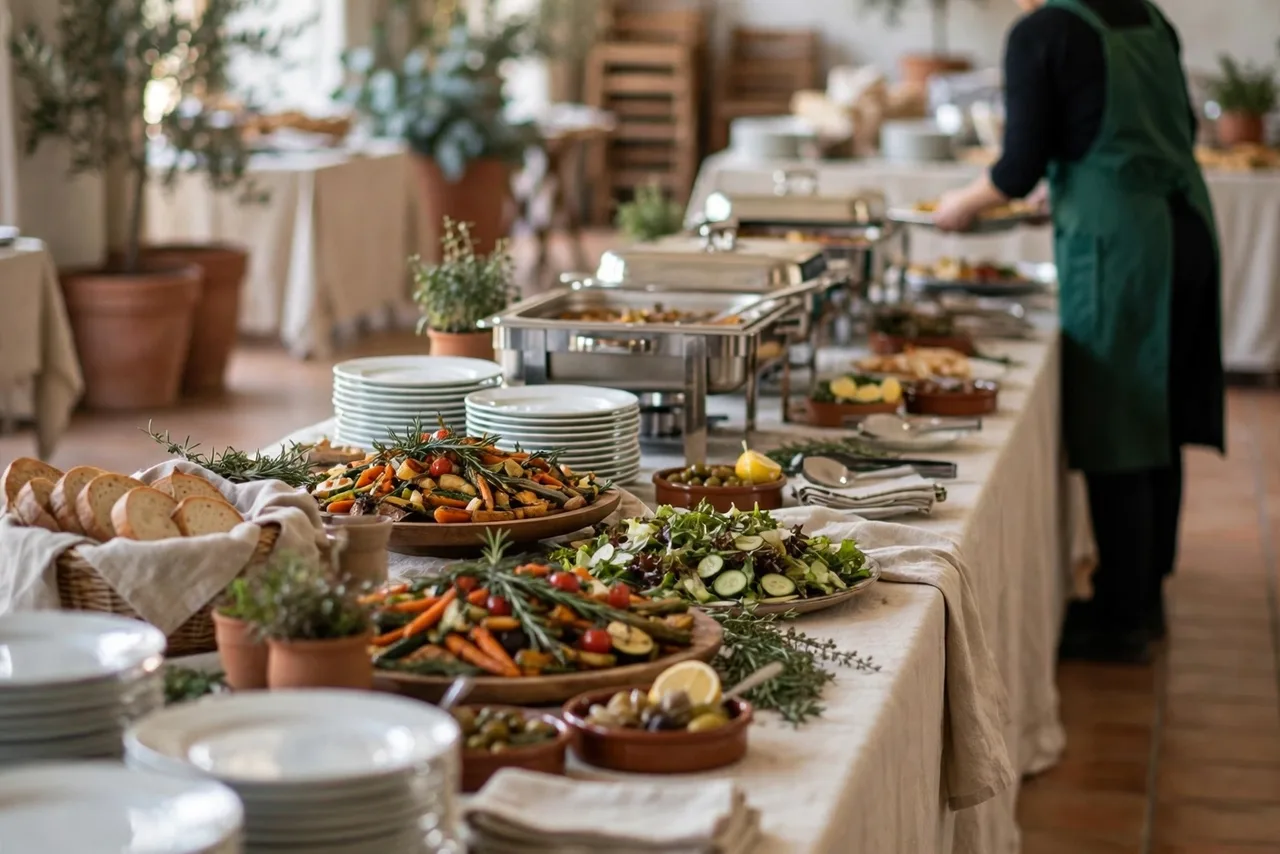
- Roasted vegetables — seasonal, cheap when you buy what is in season, and they look generous on a platter.
- Beans and pulses — a white bean ragout, a lentil salad, a chili. Protein-adjacent, cheap, satisfying.
- Breads and starches — rolls, focaccia, flatbreads. Low cost, high perceived value, they fill a table.
- Composed salads — a substantial grain or chopped salad reads as a real dish, not a side, and its cost is mostly produce.
These are not filler. Guests remember a great roasted-vegetable platter and a good bread. Designed well, the workhorses carry the margin that lets you afford the showpieces — and they are the dishes that let you say yes to a tight budget without bleeding.
Price the premium proteins at true cost
The beef tenderloin, the salmon, the lamb, the shrimp — these are why some menus lose money. They are expensive per portion, they are unforgiving on a buffet line, and clients ask for them by name. You do not have to refuse them. You have to price them at what they actually cost you, loaded, and never let a workhorse dish subsidize a protein you underpriced.
Food cost typically runs 28–35% of revenue, dropping toward 25% on high-end events (per ezCater, 2025) — and premium proteins are exactly what pushes you to the top of that band or over it. So treat them as their own line in your costing and never round down. If a client wants a menu that is all premium protein, that is a more expensive menu, and the price should say so plainly. The mistake is quoting a protein-heavy spread at a price built for a balanced one.
The balance you are after: a menu where the workhorses hold the average food cost in the healthy band, and the premium items are priced to carry their own weight. That is what lets you offer range — a budget option and a splurge option — without a single dish quietly draining the job.
Keep it tight enough to execute
A sprawling menu is a tax you pay in three currencies: prep time, waste, and mistakes. Every additional dish is another recipe to scale, another set of ingredients to buy in a quantity you might not use up, another thing that can go wrong under pressure at 5 p.m. with the client watching.
Labor runs 25–35% of revenue in a typical catering operation (per ezCater, 2025), and a bloated menu is one of the fastest ways to blow past the top of that range. A tight menu — a handful of proteins, a rotating set of workhorse sides, a few salads and breads — lets you buy in bulk, prep in batches, and get fast at the same dishes. Speed and repetition are where a small crew makes money.
Tight also means less waste. When your menu reuses components — the same herb oil across three dishes, the same base grain in two — you order fewer distinct ingredients and use more of each. Over-ordering for a one-off dish that appears on a single menu is pure loss. A caterer with fifteen dishes has fifteen ways to over-buy. A caterer with a focused, cross-using menu has almost none.
This does not mean a boring menu. It means a deliberate one. Offer variety through combination and seasonal swaps, not through an endless list.
Design for the drive
Restaurant food is served feet from where it was cooked. Catering food is served after a drive, a load-in, and a hold. A dish that is perfect on the pass and ruined an hour later has no business on a catering menu, no matter how good it tastes at home.
Some things travel and hold beautifully: braises, stews, roasted vegetables, grain dishes, most pastas, anything saucy that reheats without breaking. Some things fight you the whole way: crispy items that go soggy, delicate greens that wilt under a warm protein, anything that has to be plated à la minute, sauces that split when held. When you build the menu, sort every candidate dish into “holds” or “fights back,” and lean hard on the holds. Save the fragile, à-la-minute dishes for plated service where you control the timing, and even then, know exactly how you will execute them on site.
Temperature is the other half of transport, and it is a food-safety line, not a quality preference — hot food stays hot and cold stays cold, with a thermometer to prove it. Design the menu so you can actually hold everything safely with the equipment you own. A dish that requires a piece of gear you do not have is a dish you cannot cater yet.
Make your signature items on purpose
Somewhere on the menu you want one or two things people talk about after — the dish that gets you the referral, the item a client requests by name for their next event. Pick these deliberately. A signature item earns its place when it is memorable, reasonable to execute at volume, and priced to carry its cost. The worst signature is a labor-punishing showpiece you lose money on every time you serve it.
The best ones are often a workhorse done well: a bread you make yourself, a vegetable dish nobody expects to love, a sauce that is unmistakably yours. Cheap to produce, unforgettable to eat, and repeatable at scale.
Once the menu is built and every dish is costed, you are ready to turn those costs into prices that actually clear. That is the next chapter: food cost and pricing your catering. And if you want to see where menu design sits in the full path from idea to booked jobs, the complete playbook lays out every step in order.
Frequently Asked Questions
- How do I design a catering menu that is actually profitable?
- Cost every dish before you fall in love with it: price the ingredients per portion, load your labor and overhead, and set a margin. Build the menu around dishes that hold quality after transport, scale cleanly to a crowd, and carry a healthy margin — then anchor it with a few showpiece items. A tight, well-costed menu beats a sprawling one you cannot execute or price. The food-cost calculator in the pricing chapter does the per-dish math.
- How many dishes should be on my catering menu?
- Fewer than you are tempted to offer. A focused menu you can execute flawlessly at volume — a handful of proteins, sides, and formats you have costed and tested — is more profitable and less stressful than a long list. Tight menus reduce food waste, speed prep, and make every quote faster to build. Add signature or seasonal items deliberately, not to look bigger.
- What are high-margin catering menu items?
- Items with cheap, forgiving ingredients that read as generous: pasta and grain dishes, roasted seasonal vegetables, beans and rice, breads, and composed salads typically carry higher margins than premium proteins like steak or shrimp. That does not mean avoid the premium plates — it means price them at their true cost and let the high-margin sides carry the average. Cost each item; do not guess which ones pay.
- How does the menu affect my food cost percentage?
- Directly. Successful caterers keep food cost around 28–35% of revenue, dropping toward 25% on high-end events (per ezCater 2025). A menu heavy on premium proteins pushes that percentage up; balancing it with high-margin sides and pricing each dish to a target margin keeps the average where it needs to be. Percentages are the compass; the dollars per event are the destination.
Quote your first job in minutes, not evenings
CaterKit is built for solo and small-crew caterers — photograph your menu, send a costed, branded quote the same night, and walk into event day with auto-built shopping and prep lists. The Free tier handles 2 events a month, enough to book your first jobs, with no card required.
Get this as a 7-day course
One short email a day, the whole start-to-first-job path, written for someone doing this for the first time. Unsubscribe with one tap, any time.
You're in. Day one lands within a day. Check the promotions tab if it hides.
That didn't send. Check the address and try once more.