
Staffing and scaling a catering business past yourself
There’s a moment in every growing catering business where you can’t do the next job alone. The guest count crossed a line, or two events landed on the same Saturday, and one pair of hands isn’t enough. That’s a good problem. It’s also the moment most new caterers make their first expensive mistake — hiring the wrong way, growing ahead of their bookings, or scaling the cooking when the thing that actually broke was the coordination. This chapter is about adding help and growing capacity without any of that.
The core idea to hold onto: you scale to meet demand you’ve already proven, never to chase demand you’re hoping for. And the first thing that breaks as you grow is almost never the food.
How many hands each event actually needs
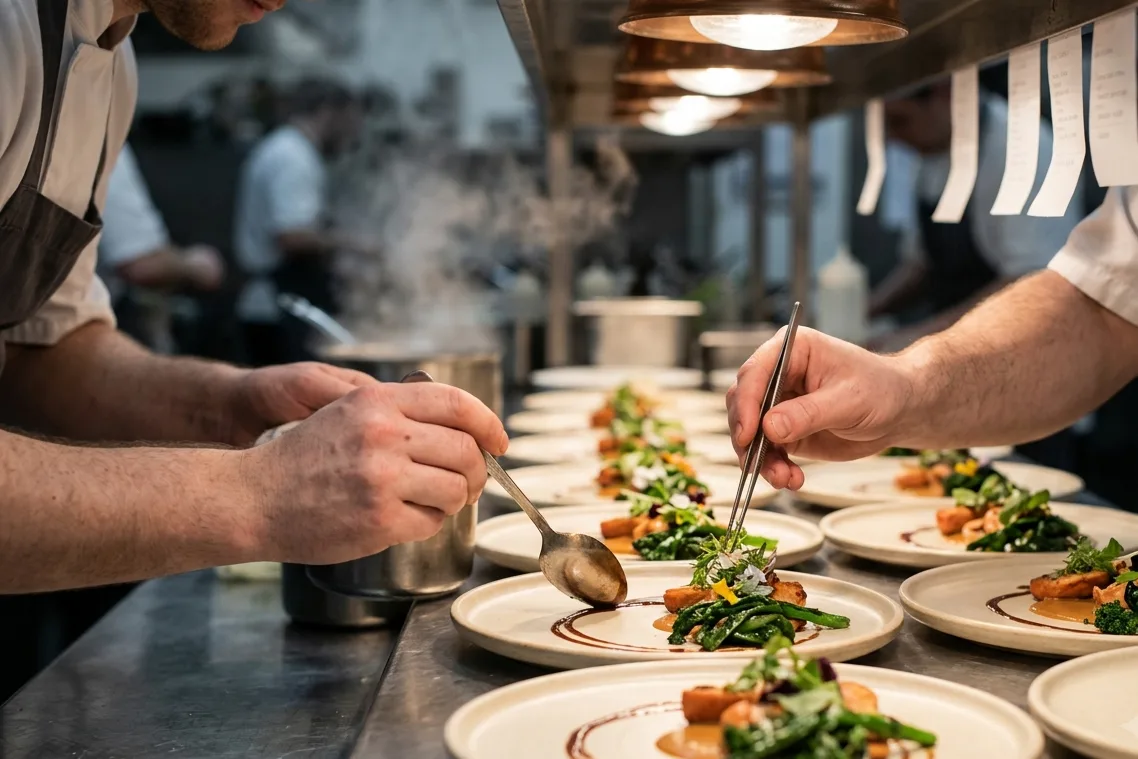
Before you hire anyone, know how much labor a given event requires, because that number drives everything downstream. Staffing follows service style, and the ratios are well established. For a buffet, plan on roughly one server per 20 guests. Plated service is far more labor-intensive — about one server per 10 to 12 guests, because every plate is carried, set, and cleared. Passed cocktail hour runs around one server per 25 guests, and a rough baseline across service styles is about one server per 32 guests (per industry staffing guides, 2025).
Use these as your starting math, not gospel. A tight venue, a long service window, or a demanding menu pushes the ratio up; a simple drop-and-go pushes it down. The point is that “how many people do I need” has an answer you can calculate before the event, not a guess you make the morning of. Build the staffing line into your quote from the ratio, so the client is paying for the labor the event requires — this is part of the same discipline covered in food cost and pricing your catering menu, where labor is one of the numbers your price has to cover, not absorb.
What event staff cost — and why you pay per event
Catering servers average about $16.91 per hour in 2025, commonly landing anywhere from roughly $15 to $25 depending on your market and how experienced the person is (per ZipRecruiter, 2025). That’s the wage. The structural decision — and it’s the important one — is that early on you pay this per event, not as a salary.
Event staff are the textbook variable cost. You bring them on for the six or eight hours a job needs, you fold their hours into that job’s quote, and when the event is over the cost is over. A salaried employee, by contrast, gets paid in January and February whether or not you booked a single event — and with catering’s calendar swinging between spring and fall peaks and a dead winter, a fixed payroll during the trough is exactly the kind of weight that sinks thin-margin operators. Labor already runs about 25–35% of revenue in this business (per ezCater, 2025); the way you keep that percentage from becoming a fixed monthly obligation is to keep it variable, scheduled against actual booked work.
So build a roster, not a payroll. Keep a bench of reliable servers you can call per event, pay them for the hours the job needs, and let the size of your crew flex with the size of your calendar. In the peak you staff up across a Saturday’s events; in the trough you owe no one a paycheck for weeks you didn’t book.
Hire for the peak without overcommitting
Your busy months need more hands than your quiet months, and the trick is meeting the peak without carrying its cost year-round. The roster model does most of this work for you: a deep enough bench means you can field a big spring Saturday without any of those people being an obligation the following February.
- Build the bench before you need it. Recruit and do a trial run with new servers in the slow months, not the week of a wedding. A server who’s already worked one calm event for you is worth far more than a stranger you’re meeting at a 150-guest job.
- Keep a core you trust and a wider call list. A handful of people who know your systems cold, plus a longer list you can pull from when several events stack up. The core carries quality; the list carries volume.
- Let the calendar set the crew size. Staff each event from its ratio and its booking, not from a headcount you feel you should maintain. Empty Saturdays should cost you nothing in labor.
- Never let a big booking outrun your bench. If you take a job bigger than you can reliably staff, you haven’t grown — you’ve gambled your reputation on strangers. Grow the bench first, then take the job the bench can cover.
The timing of all this lines up with your cash flow. Recruiting and training happen in the quiet season so your peak runs on people you already trust — the same logic laid out in wedding season, event peaks, and cash flow. Hire ahead in March; don’t scramble in May.
Add capacity only for demand you’ve proven
Here’s the discipline that separates operators who grow from operators who overextend: you add capacity to serve demand you can already see on your calendar, never to prepare for demand you imagine is coming.
It’s tempting to run it backwards — sign the kitchen lease, buy the second set of equipment, and put people on standing hours because you feel growth in the air and want to be ready. That’s how a caterer ends up with a fixed monthly nut and not enough bookings behind it to cover it. In a business where net margins typically sit around 7–15% (per ezCater and Checkmate, 2025), there is no room to carry idle capacity for months while demand “shows up.”
Do it in the proven order instead. When you’re consistently turning away work you can’t staff or produce, that’s your signal to add a rung — more servers on the bench, more kitchen hours, more equipment. The bookings justify the capacity; the capacity doesn’t summon the bookings. Let the work you’ve actually landed pull you into your next size, and every expansion is paid for by demand that already exists rather than demand you’re betting on.
The one thing you don’t stretch to grow is quality. Keep quality the binding constraint — grow only as fast as you can add hands and capacity without the food or the service slipping. A caterer who doubles volume and halves the experience hasn’t scaled a business; they’ve diluted the only thing that gets them the next booking.
Systemize the coordination before you scale the cooking
Ask any caterer what actually breaks when volume climbs and the honest answer is never “I couldn’t cook enough.” Cooking scales in fairly predictable steps — more pans, more hours, more hands. What breaks first is coordination: which deposit came in, what’s on which menu, who’s staffing Saturday’s second event, what has to be prepped and packed and loaded and in which order. Order-management chaos as the volume grows is one of the well-documented reasons new food businesses stumble (per FasterCapital and findhomegrown, 2025), and it hits precisely at the moment success is supposed to feel good.
So systemize the paperwork before you grow into the volume that overwhelms it. Get these running as repeatable processes while you’re still small enough to fix them calmly:
- Quoting — a consistent way to price every job from the same food-cost, labor, and margin math, so numbers don’t depend on your mood the day the inquiry lands.
- Booking and deposits — a clear record of what’s confirmed, what’s tentative, and which deposits have actually cleared, so no event is a surprise and no deposit gets spent twice.
- Prep and pack lists — a written build for every event: what gets made, what gets loaded, in what order, down to the last serving spoon.
When these live in a system instead of your head, you can hand parts of them off, run two events on one day without dropping either, and take on more volume without the coordination collapsing. Try to scale on memory and sticky notes and you’ll hit a ceiling that has nothing to do with how well you cook. Build the systems first; the cooking was never the bottleneck. When you’re ready to line these decisions up in sequence, head back to the start hub.
Two things change the first time other people work your events. The day-of coordinator stops being a title on a run sheet and becomes the person who decides when your food goes out, so it is worth knowing what they are responsible for and what they are not. And the food-safety certification your staff need is set locally rather than nationally, including for the server you hire for one Saturday: check what applies where you cook in catering license requirements by state.
Frequently Asked Questions
- How many staff do I need for a catering event?
- It depends on service style. Common ratios are about one server per 20 guests for a buffet, one per 10–12 for plated service, and one per 25 for a passed cocktail hour, with a baseline many caterers use of roughly one server per 32 guests (per industry staffing guides 2025). Add kitchen help and a lead for larger events. Under-staff and service (and food temperatures) slip; over-staff and the event's margin evaporates.
- What do catering servers and event staff cost?
- Catering servers in the US average around $16.91 per hour as of 2025, commonly ranging from about $15 to $25 depending on market and experience (per ZipRecruiter 2025). Build staffing into your per-event pricing as its own line, and remember labor overall typically runs 25–35% of catering revenue (per ezCater 2025). Event staff are usually scheduled per event rather than kept on salary until volume justifies it.
- When should I hire help or grow beyond solo?
- When you are consistently turning down jobs you could fill, or an event no longer fits what one or two people can execute safely. Add capacity to meet proven demand, not ahead of it — every hire and every piece of owned equipment is a fixed cost that only pays off against bookings you can actually win. Grow into demand you can see, and keep quality the constraint.
- What breaks first when a catering business grows?
- Coordination. What fits in your head for a few events a month — dates, quotes, deposits, guest counts, prep and pack lists — collapses when the volume climbs and a second event overlaps the first. Systemize quoting, booking, deposits, and the day-of prep and packing before you scale, or growth just multiplies the mistakes and the missed details.
Quote your first job in minutes, not evenings
CaterKit is built for solo and small-crew caterers — photograph your menu, send a costed, branded quote the same night, and walk into event day with auto-built shopping and prep lists. The Free tier handles 2 events a month, enough to book your first jobs, with no card required.
Get this as a 7-day course
One short email a day, the whole start-to-first-job path, written for someone doing this for the first time. Unsubscribe with one tap, any time.
You're in. Day one lands within a day. Check the promotions tab if it hides.
That didn't send. Check the address and try once more.